
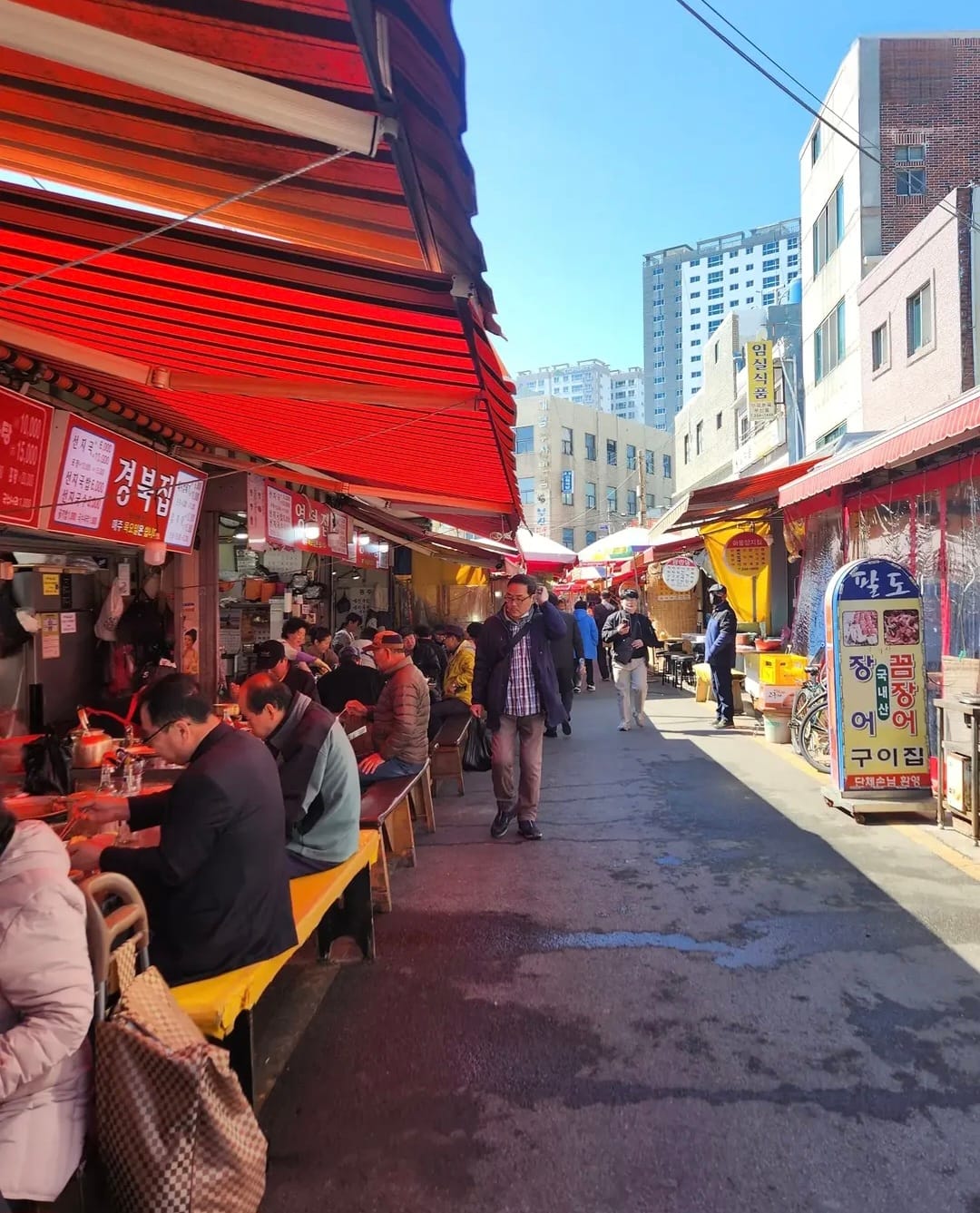
When people think of Busan food, seafood usually comes to mind first. But ask any Korean who travels to Busan regularly, and they’ll tell you the same thing: you haven’t really eaten in Busan until you’ve had Busan gukbap.
Seoul has its share of good gukbap spots, but Busan is where this dish was born. The broth is darker and richer than what you’ll find up north, and locals pile in generous handfuls of fresh chives before taking their first sip.
You’ve probably already come across the famous names — ‘Bonjeon Dwaeji Gukbap’, ‘Hapcheon Gukbap’
but today I’m sharing the places I actually go to every single time I visit Busan. I travel to Busan at least twice a year, and these two spots are non-negotiable on my list.
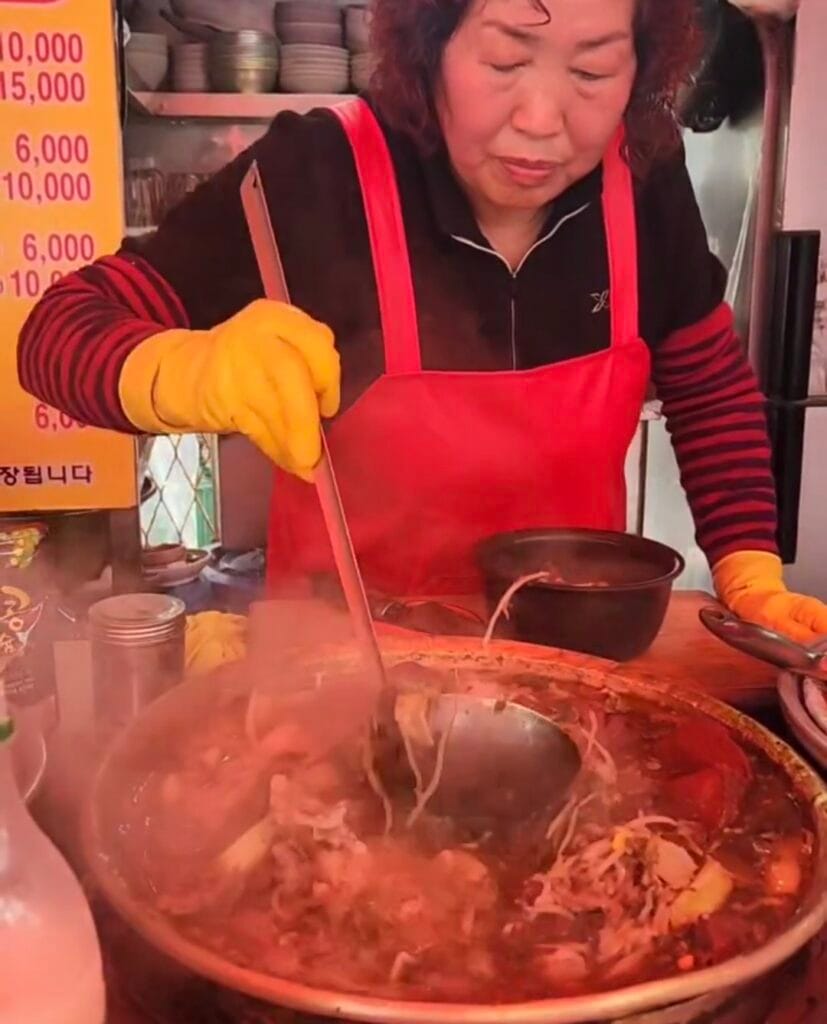
1.Gyeongbuk-jip at Jagalchi Market
Of all the food Jagalchi Market has to offer,
this pojangmacha (street food tent) holds a special place for me. It’s not about the food alone — it’s about the feeling of sitting elbow-to-elbow with strangers in a cramped canvas tent, ordering a bowl of gukbap (Soup) and a bottle of makgeolli in the middle of the afternoon, and feeling like you’ve stumbled into the real Busan.
This is not the polished, tourist-friendly version of pojangmacha culture you might find in Seoul.
This is the original — rough around the edges,
full of regulars, and completely unpretentious.
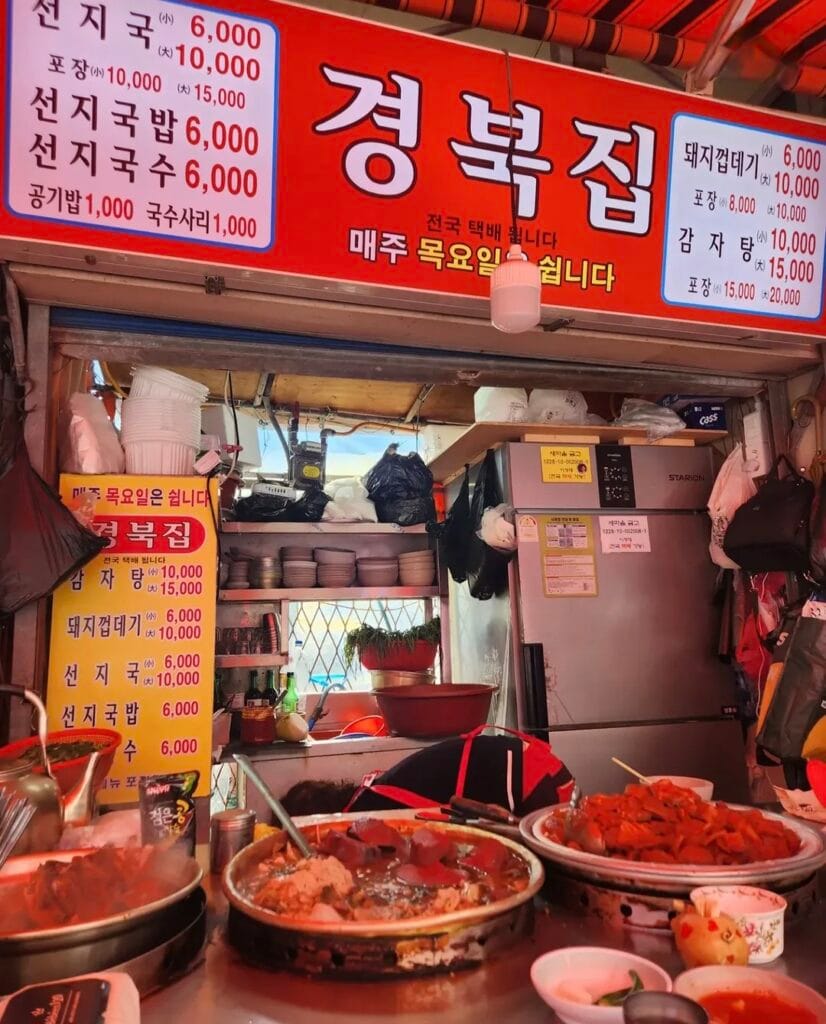
Gyeongbukjip Busan Gukbap Menu
The menu centers around three dishes that are beloved by locals but may be completely new territory for foreign visitors: Korean blood curd soup with rice, Pork Bone Potato Stew,
and Stir-fried pork skin
✔️Korean blood curd soup with rice (Seonji Haejangguk)
It is a soup made with congealed ox blood. The blood is solidified into soft, jelly-like cubes — similar in texture to silken tofu, but with a rich, iron-forward depth.
If you’re familiar with black pudding (UK) or boudin noir (France), think of it as Korea’s answer to that tradition.
It’s high in iron, said to be good for the liver, and is one of Korea’s most trusted hangover cures — “haejangguk”
literally means “soup to dissolve a hangover.”
The flavor is similar to the liver filling inside sundae (Korean blood sausage), but the texture is uniquely smooth and wobbly.
✔️Pork Bone Potato Stew (Gamjatang) is one of Korea’s most popular comfort foods — pork bone slow-cooked with soft potatoes, vegetables, and a gochujang-based broth until everything is deeply tender. you pull the meat off with your chopsticks, dig out the marrow, and let the spicy, savory broth do the rest. Gamjatang is typically served for 2–3 people; the single-serving version cooked in a stone pot is called
“bbyeo haejangguk” (bone hangover soup).
✔️Stir-fried Pork Skin (Dwaeji Kkeob-deogi)
pork skin — might already be familiar if you’ve tried it grilled at a Korean BBQ restaurant. Here at Gyeongbukjip, it’s done pojangmacha-style: stir-fried in a spicy, savory sauce rather than grilled. It’s a different experience entirely.
1) Korean blood curd soup ₩7,000
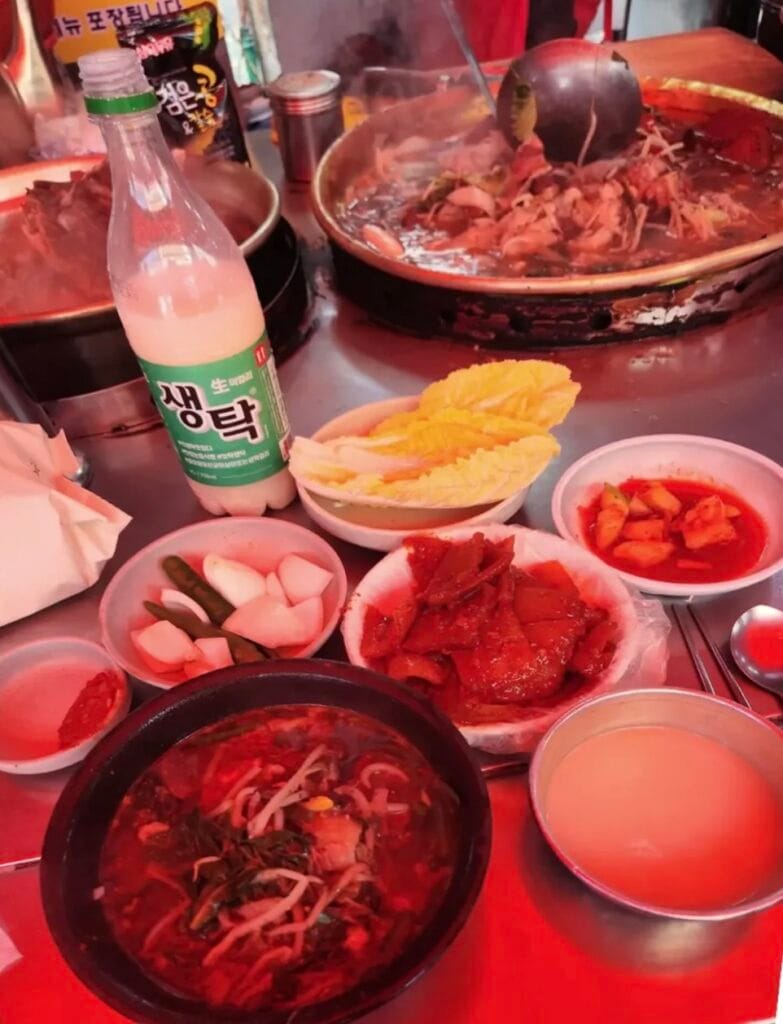
Seonji gukbap and Seonji guksu are essentially the same dish — the only difference is whether you add rice or noodles to the broth. I usually go with the noodle version, and since I always order makgeolli with my meal, so I ask for half the noodles and extra seonji instead (plenty of carbs)
The broth is free-flowing refills.
Once you’ve finished your soup and OX blood curd (seonji), just ask for more — and they’ll bring you a fresh, piping hot bowl filled to the brim. That kind of generosity is what traditional Korean markets are all about. Since refills are unlimited,
always order the small size.
2) Stir-fried Pork Skin — ₩6,000
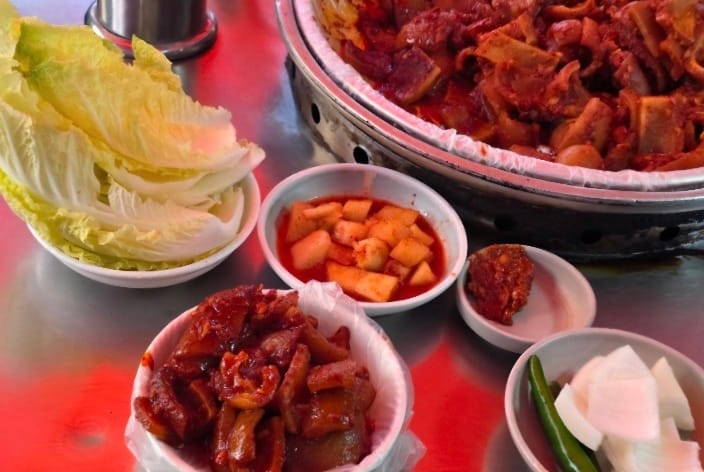
It’s still incredible value for what you get. The stir-fried pork skin isn’t quite as mind-blowing as the seonji haejangguk, but it’s genuinely hard to find this preparation style anywhere else, so I’d recommend giving it a try.
It comes with vegetables and ssamjang (dipping paste). Take a piece of pork skin, wrap it in a leaf with a dab of ssamjang and some sliced onion, and pop the whole thing in your mouth. You’ll want something to wash it down — one spoonful of seonji broth does the job perfectly.
Absolute heaven.
Getting to Gyeongbuk-jip
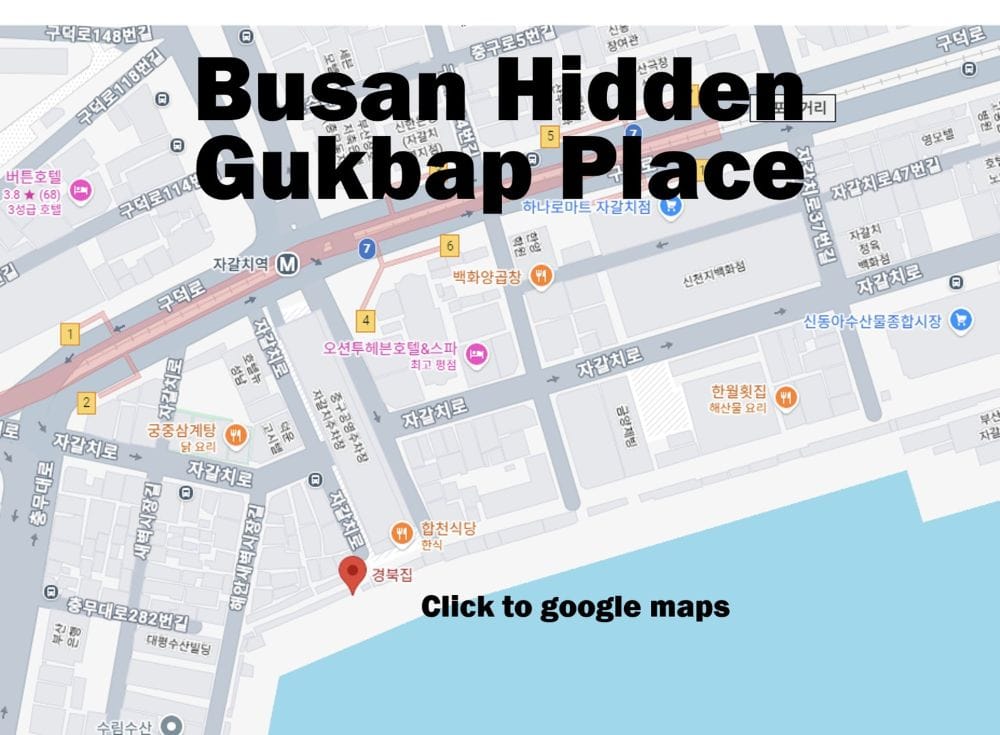
✔️Directions:
Exit 4 of Jagalchi Station → pass the parking tower → walk straight to the end of the alley on the right.
Once you pass the raw fish restaurants in Jagalchi Market, you’ll see a cluster of pojangmacha tents selling seonji haejangguk and gamjatang. That’s the spot.
✔️Hours: 07:00–19:00 (closed Thursdays)
✔️Practical notes: Public restroom only.
No space for luggage or rolling suitcases — the market path is uneven and too narrow for carriers.
For foreign visitors, the two main hurdles here are the uneven ground (no rolling suitcases) and the public-only restroom situation. But these are minor inconveniences compared to what you get in return: the atmosphere of an old-school Korean market that hasn’t changed in decades, the warmth of the ajeossi and ajumma running the stalls, and the particular pleasure of walking around slightly buzzed in the middle of a weekday afternoon.
✔️My personal TIP!
I arrive at Busan Station, drop my luggage in a station locker, hop on the subway straight to Jagalchi, and use this meal as my official Busan arrival ritual. After eating, I walk back to Busan Station through Nampo-dong to sober up. Highly, highly recommended.
Is Gyeongbuk-jib in Busan worth recommending to international visitors?
Gyeongbuk-jib is a place that can divide opinions, even among locals. Because it is located right in the heart of Jagalchi Market, I honestly cannot recommend it to those who are sensitive to hygiene or modern convenience.
However, this spot is a hidden gem known only to true Busan natives. Having stood alongside the history of Jagalchi Market for decades, I highly recommend experiencing it at least once. You will be able to feel the genuine warmth and generosity of Koreans through their unlimited refills of hearty blood curd soup
| If you’re based in Seoul and craving Busan-style gukbap, check out my review of Gwanghwamun Gukbap a Michelin Bib Gourmand recipient for 9 consecutive years. |
| If you are interested in the second restaurant featured in my Busan Gukbap series, ‘Gyeongju Parkga Gukbap’ please check out the full review Busan Pork Soup Guide 2: Gyeongju Parkga Gukbap |